SKU:53082C
Cross Peen Hammer – Hardened Steel Head, Fibreglass Anti-Vibration Shaft, Bi-Material Red Black Grip
Cross Peen Hammer – Hardened Steel Head, Fibreglass Anti-Vibration Shaft, Bi-Material Red Black Grip
- Weight: 700g
- Size: 30x20x10cm
Currently 50 items are in stock!
Shipping: We Use Evri and Royal Mail Tracked 48 Services. Please do not send us Yodel and Relay Labels.
Upload your label and get free shipping using the IHAVELABEL code on checkout
Couldn't load pickup availability
The Hammer That Does What Others Cannot
Most tool kits have a claw hammer. Some have a ball peen. Very few have a cross peen — and yet for anyone who does joinery, metalwork, or light engineering, it is the head shape that fills the gap the other two leave. The cross peen is a wedge-shaped striking surface that runs at 90 degrees to the handle shaft. That orientation means it spreads material in one direction only — along a line rather than uniformly outward — and that specific directional control is what makes it genuinely useful for tasks that neither a round ball nor a flat claw can handle as well.
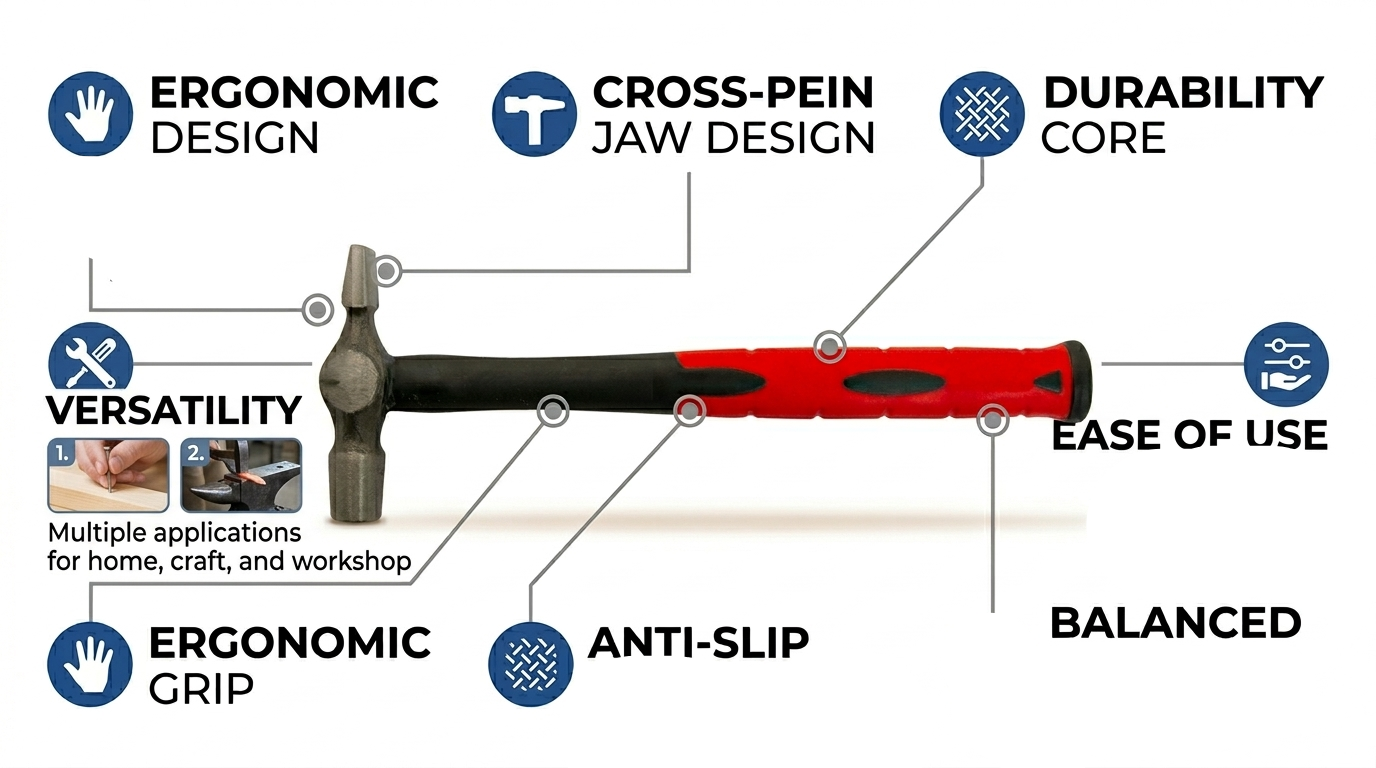
This cross peen hammer has a hardened steel head with a flat striking face on one end and a cross-oriented wedge peen on the other, on a fibreglass anti-vibration shaft with a bi-material red and black over-moulded grip.
The Two Ends and What Each Is For
Flat striking face — the driving end The flat hardened face handles general striking — driving nails, setting fasteners, striking cold chisels and punches, and any task where a direct square blow is needed. Hardened to maintain its flat profile through sustained use. The face you use for the majority of driving tasks.
Cross peen — the directional working end The wedge runs perpendicular to the shaft. A strike with the peen spreads material along one axis only — not uniformly outward like a ball peen. The practical uses this unlocks:
- Starting panel pins and tacks single-handed — hold the pin between fingers while using the narrow peen to tap it in. The peen face is small enough that a slightly missed strike does not catch the fingers the way a full flat face would. Once started, switch to the flat face for driving.
- Spreading metal along a seam or join line — the directional spread follows the peen edge orientation, drawing material out in one direction.
- Peening rivets with control — spreading the shank along a specific axis rather than uniformly, which matters in fitted engineering and light fabrication.
- Working into corners and grooves — the wedge profile accesses surface areas a ball peen cannot reach cleanly.
Why Fibreglass Rather Than Wood
A wooden handle looks traditional and feels familiar. It also expands when damp, contracts when dry, and gradually loosens from the head through the seasonal cycle of humidity changes in a workshop or outdoor environment. Over time that means re-wedging, or a head that is not as secure as it should be.
Fibreglass does not absorb moisture. It does not change dimension. The head-to-shaft connection stays tight in outdoor conditions and variable workshop environments without periodic attention. It also absorbs more strike vibration than wood of the same shaft dimensions — the composite structure dampens the impulse before it reaches the hand, which matters when cross peen work involves repetitive precision strikes over an extended session.
The Handle Grip
The bi-material over-mould combines a rigid fibreglass core — for direct torque and force transfer — with a soft red outer layer that cushions hand pressure on every strike. The black sections are structural grip zones; the red provides the comfort cushioning. The handle profile narrows toward the head and flares at the butt — the shape that stops the hammer sliding forward during a swing and allows a relaxed grip rather than a constantly tight hold.
Features at a Glance
- Hardened steel head — both face and peen hardened for sustained driving and metalwork use
- Flat striking face — machined flat, maintains profile through regular use
- Cross peen — perpendicular wedge for directional metal spreading, pin starting, rivet peening
- Fibreglass shaft — moisture resistant, dimensionally stable, anti-vibration
- Bi-material red and black grip — soft cushioned outer over rigid core; ergonomic handle profile
- Single-handed pin starting — narrow peen allows pin tapping without fingertip exposure
- Balanced head — even mass distribution between face and peen for natural swing in both orientations
Where This Gets Used
Finish joinery and interior trim work, panel pin starting in skirting and architrave, metalwork and light fabrication, rivet setting and peening, cold chisel and punch driving, engineering workshop assembly, and any task where a flat face and a directional peen on one tool reduces bench clutter and provides functions neither a claw nor a ball peen can replicate cleanly.
Specifications
| Detail | Specification |
|---|---|
| Head Type | Cross peen — flat face + cross wedge |
| Head Material | Hardened steel |
| Face | Flat — hardened — machined |
| Peen | Cross (90° to shaft) — hardened |
| Shaft | Fibreglass — anti-vibration |
| Grip | Bi-material over-mould — red / black |
| Handle | Ergonomic profile — flared butt |
| Best For | Joinery, metalwork, engineering, workshop |